

June 25, 2026

7
min read
AI Governance: Turning Regulation into Advantage
In 2026, AI governance has evolved from a compliance checklist into a core strategic priority for any enterprise running AI in production.
In 2026, AI governance has evolved from a compliance checklist into a core strategic priority for any enterprise running AI in production.
As AI systems move beyond the sandbox into real-time decision-making, automation, and risk management, organizations must architect robust governance frameworks that do more than just manage risk. They must ensure regulatory alignment, operational visibility, and long-term trust.
In an era where AI agents can decide, act, and execute independently, governance becomes foundational. It is a structured system of policies, oversight mechanisms, and operational safeguards that ensure AI is deployed responsibly.
At its core, governance aligns AI behavior with both internal business goals and external regulatory expectations. As AI becomes embedded in everyday tools and workflows, effective governance ensures its behavior remains transparent, ethical, and defensible - extending beyond static models to dynamic, real-world actions.
Effective AI governance requires a transition from high-level policy to operational visibility. It can no longer focus only on the model in isolation. It must extend to the full operational environment in which AI functions - where decisions are made, actions are executed, and risks emerge in real time. This involves creating a persistent "source of truth" to monitor every touchpoint where AI interacts with data, humans, or other automated systems.
A resilient governance program is built upon pillars that balance technical integrity with ethical responsibility. These pillars ensure that AI systems operate reliably across their entire lifecycle, from initial training to decommissioning. By focusing on these core areas, organizations can build deep-seated trust with regulators, shareholders, and customers alike.
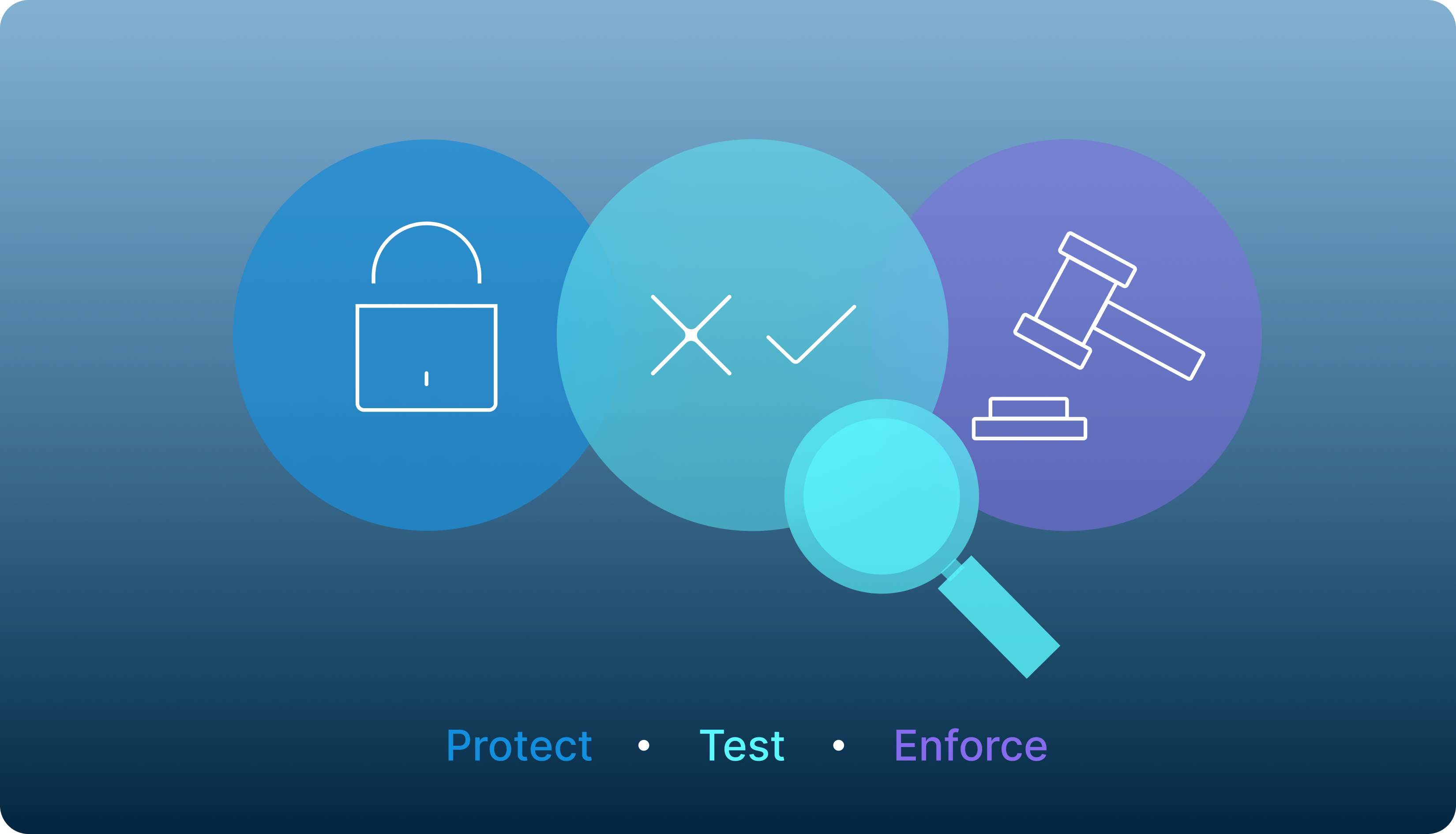
Guidelines like PROTECT, TEST, and ENFORCE serve as the bridge between abstract ethical values and executable technical standards. They provide the "rules of the road" to ensure every AI system is fortified before touching production data or customer interfaces, with controls aligned to risk levels defined by frameworks like the EU AI Act (e.g., high-risk use cases get stricter treatment).
This process begins with foundational PROTECT measures such as Live Data Redaction & Access Control, mandating strict PII stripping and granular access controls to maintain compliance with global privacy mandates.
The integrity of these systems is then verified through TEST measures such as AI Resilience and Stress Testing, where "Red Team" simulations are used to challenge agentic workflows against manipulation before they are greenlit.
Finally, the system is secured in live environments through ENFORCE measures such as Active Output Enforcement, which utilizes real-time interceptors to filter policy-violating content or unauthorized responses before they reach consumers or payment rails.
AI governance begins as a leadership mandate to bridge the gap between technical security and executive oversight. By establishing a cross-functional AI Governance Committee - typically comprising the CCO, CIO, Chief Risk Officer, legal counsel, and representatives from security, product, and ethics teams - organizations can transition from opaque "black box" operations to documented, traceable systems. This committee should meet periodically and report directly to the board risk committee.
This includes defining ownership across legal, security, and product teams, along with established review and escalation workflows for AI deployments and incidents.
Governance cannot scale without measurement. KPIs turn principles into enforceable standards. To ensure that governance isn't just a "paper exercise", organizations must establish a robust framework of Key Performance Indicators (KPIs). These metrics provide the data necessary for continuous improvement and risk mitigation, allowing leadership to prove the value of their governance investments to external auditors and internal stakeholders.
Operationalizing AI governance is an iterative process that demands constant vigilance. Because AI models are inherently dynamic, the controls used to manage them must be equally agile. This centers on a continuous cycle of monitoring, auditing, and proactive remediation.
For example, a fraud detection model that performs well today may degrade as user behavior evolves, making continuous monitoring essential.
In 2026, AI governance is the bridge between potential and production. The question is no longer whether you use AI. Rather, it is whether you can govern it in real time, at scale, and with confidence. By establishing these frameworks early, institutions can transform regulatory pressure into a strategic advantage.
Organizations that adopt modular, governance-first architectures will move faster and safer. Platforms like HugoHub illustrate how orchestration layers can embed real-time guardrails, enabling AI systems to scale responsibly while maintaining control.
.png)

.png)